
Lac qui Parle Projected Release Dates
The Minnesota Department of Corrections uses the exact label “Anticipated Release Date.” It is a forward-looking calculation for a person within the department’s public Locator scope. It is not the same as a jail door-exit time, a final discharge date, or proof that a release happened. Current Status becomes the first field to check after that date passes.
A county jail case works differently. A person held before trial may have no date that can be calculated. Release can depend on bail and conditions, a court order, warrant and hold checks, or completion of jail processing. Even a bail receipt on the county roster does not prove that discharge is complete. For a short county sentence, the sheriff and the district court are the correct sources for the jail calculation and sentencing order.
Scheduled versus actual: An anticipated date estimates a future change in custody status. Actual release requires a later status check or release record.
A person can also leave prison and enter supervised release. That is a real physical release from prison, but the sentence continues in the community. Expiration Date may mark the end of DOC jurisdiction rather than the first day outside prison. Those dates answer different questions.
Find Lac qui Parle Release Dates
Begin with the type of custody, not with a date calculator. The statewide Locator covers people committed to the Commissioner of Corrections who remain under MN DOC jurisdiction. It can include incarcerated people and people already released from prison but still under supervision. It does not serve as a Lac qui Parle County Jail lookup, nor is it a full archive after final discharge.
- For a state prisoner, open the Minnesota DOC Locator. Search by the complete six-digit MNDOC Offender ID or by first and last name.
- Choose the correct person. Name searching is prefix-based and can use name history, aliases, and names tied to prior convictions, so the displayed legal DOC name may differ from the search term.
- Read Sentence Date, Anticipated Release Date, Expiration Date, Current Status, caseworker, offense, and court-file numbers as a group. Save the full context rather than one date.
- For a county pretrial or short jail sentence, contact the Lac qui Parle County Sheriff and check the district-court order. Ask for the existing calculation or release record tied to the booking.
- After the anticipated date, confirm Current Status and use the facility, caseworker, Minnesota Haven, or an actual DOC record. A future-date image cannot establish completion.
The county’s full search and release-record routes are explained on the Lac qui Parle County released inmates page. That path helps when a person left the jail roster and the question is whether the event was release, transfer, or another movement.
Note: Newly sentenced people may take several business days to appear in the Locator, so an early missing result does not resolve custody status.
Lac qui Parle DOC Release Fields
The Locator detail screen provides more than a projected date. A correct reading uses identifiers and status fields to make sure the record belongs to the right person and that the date has the intended meaning. It can display front and side DOC photographs, a birth date, alternate names, caseworker information, offense details, and links tied to court and BCA information.
| Locator field | How to read it |
|---|---|
| MNDOC Offender ID | The complete six-digit state identifier used to distinguish people with similar names. |
| Current Status | Shows whether the person is incarcerated or in another current DOC jurisdiction status. |
| Sentence Date | Anchors the sentence record but does not by itself calculate release. |
| Anticipated Release Date | The forward-looking prison-release calculation shown by MN DOC. |
| Expiration Date | May reflect the later end of DOC jurisdiction, not the prison exit date. |
| Caseworker | Identifies an active case or supervision contact when one is listed. |
| Court-file number | Connects the DOC entry to the sentencing case and later court orders. |
The official Minnesota DOC Locator displays the search used for state-prison release dates.
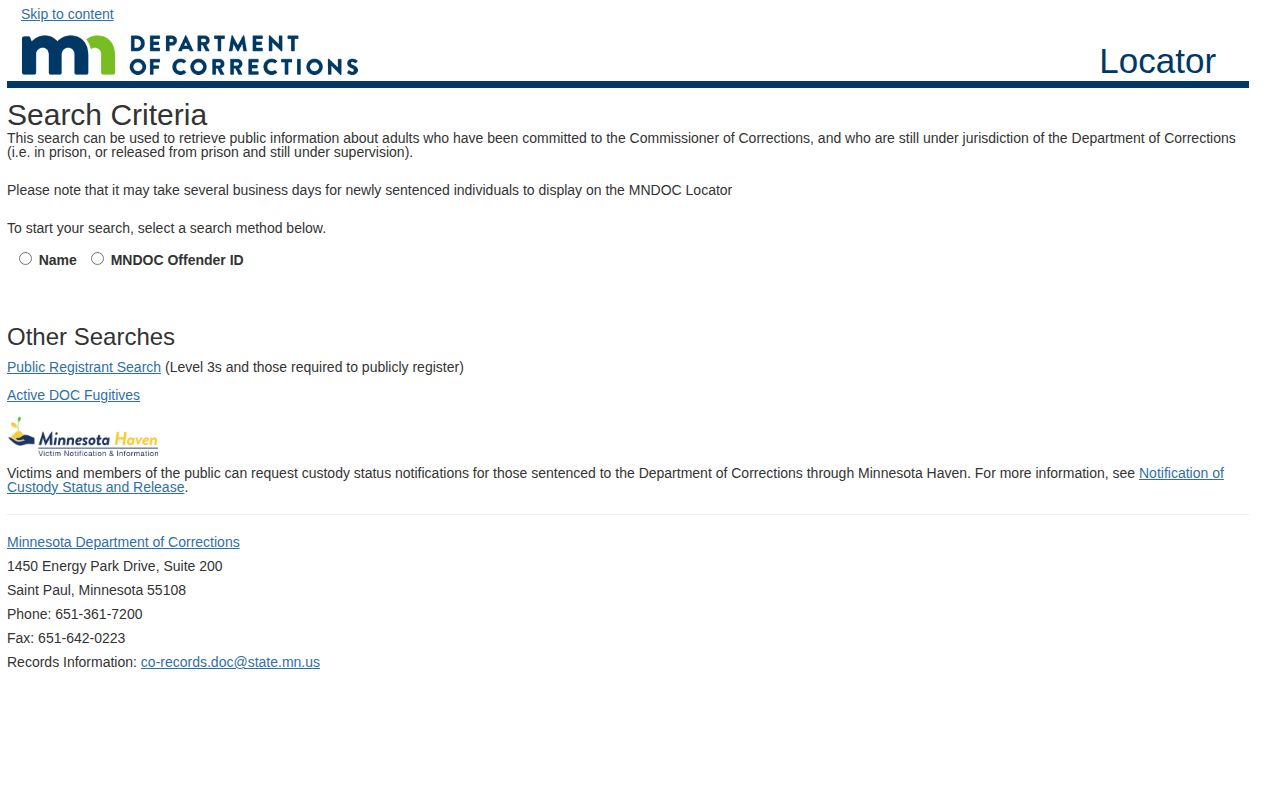
The captured search screen is appropriate only when the person was committed to MN DOC. An ordinary county bond release or local jail sentence stays with sheriff and court records unless the person separately enters state jurisdiction.
Minnesota Fixed Sentence Release Math
Minnesota should not be described as an 85-percent state. For fixed executed felony sentences for crimes committed on or after August 1, 1993, Minnesota Statutes section 244.101 generally divides the sentence into a minimum imprisonment term of two-thirds and a maximum supervised-release term of one-third. The court is directed to explain the total sentence, prison portion, and supervised-release portion on the assumption that no disciplinary confinement changes the calculation.
A 36-month fixed executed sentence illustrates the structure. The conceptual split is 24 months in prison and 12 months on supervised release before case-specific changes. The sentence does not end at month 24. Instead, the person ordinarily moves from prison confinement to community supervision and remains subject to the sentence.
Fixed-sentence flow: Court sentence → prison term → anticipated release → supervised-release term → final expiration or discharge.
Section 244.05 governs supervised release and disciplinary effects. Offense date remains essential because older offenses may fall under an older good-time system. Life and indeterminate sentences may require Supervised Release Board action and a parole eligibility date instead of the ordinary arithmetic split.
Lac qui Parle Earned Release Credit
The Minnesota Rehabilitation and Reinvestment Act adds earned incentive release credit for eligible cases. Under section 244.41 and section 244.44, credit is tied to objectives in an individualized rehabilitation plan. The current cited law allows credit in the imprisonment calculation. It does not add time to the supervised-release portion.
The credit is capped at 17 percent of the total executed sentence and cannot reduce imprisonment below one-half of the executed sentence. Those are limits, not a promise that every eligible person receives the maximum. The person’s plan, progress, eligibility, sentence, discipline, and official computation control the date.
Section 244.45 excludes life sentences, certain older indeterminate sentences, and people governed by older good-time systems. Older cases may instead require review under section 244.04. Applying a modern formula to an excluded sentence can produce a false date.
Note: Sentence credit changes an official calculation only when the governing law and corrections record apply it to that person’s case.
Lac qui Parle Release Date Changes
An anticipated date can move before release. Some causes change the sentence computation itself. Others change where a person goes on the scheduled day. A detainer, for example, may require transfer to another agency instead of release into the community. That distinction is why the date and Current Status must be read together.
| Factor | Possible effect | Record to check |
|---|---|---|
| Disciplinary confinement | Can postpone release or affect applicable credit | MN DOC sentence and discipline record |
| Earned incentive credit | Can reduce eligible imprisonment within statutory limits | Official DOC computation and rehabilitation plan |
| Amended court order | Can alter the sentence or credit applied | District-court docket and signed order |
| Consecutive or concurrent terms | Changes how multiple sentences combine | Judgment and DOC computation |
| Jail credit correction | Can move the calculated prison date | Court order and sentence calculation |
| Detainer or hold | May change the destination rather than the sentence end | Releasing and receiving agencies |
| Board action | May grant, continue, rescind, or condition a date in covered cases | Board schedule, minutes, and DOC status |
A transfer to another custody system can also remove someone from a Minnesota facility without producing community release. County, state, federal, and immigration systems keep separate records. Follow the receiving agency when the release record shows a transfer or hold.
Lac qui Parle Weekend Release Dates
Minnesota Statutes section 244.05, subdivision 1a, contains a date-shifting rule for the offense-date groups described in the law. A scheduled Friday, weekend, or holiday date can move to the prior or next qualifying weekday under the statutory conditions. The exact offense date and current statute must be applied before stating which day controls.
No Lac qui Parle County-specific good-time or weekend-release policy was located in the official research. That absence should not be filled with a local rule borrowed from another jail. For a short county-jail sentence, ask the sheriff how the signed order and jail calculation apply to that booking. The court provides the legal order, while jail staff maintain the physical release process.
This also explains why a predicted calendar date is weak evidence. A state date can shift under governing law, and a county release still requires court authority, hold checks, and jail processing. Confirm the actual event after it occurs.
Lac qui Parle Board Release Dates
The Minnesota Supervised Release Board handles defined discretionary cases rather than every prison sentence. Its covered work includes specified life, indeterminate, certified-adult, juvenile-at-offense, and criminal-sexual-conduct matters after the relevant minimum or parole eligibility date. The Board may set a projected release date or continue review with directions that must be met.
Its official schedule page provides future meetings, agendas, a current review-schedule document, streaming details, and approved minutes. The research found that minutes remain posted for about 90 days. There is no separate permanent name-searchable decision database identified.
A grant or assigned date is still not an actual release record. Confirm through MN DOC Current Status, the listed caseworker, Minnesota Haven, or the department’s records process. The board decision may set the legal path, while corrections staff document whether and when the person left prison.
Confirm Lac qui Parle Release
After the anticipated day, return to the current source. For a state case, check MN DOC Current Status and the caseworker field. Minnesota Haven is the separate state-prison notification service. Minnesota VINE instead covers participating county jail and detention custody. The distinction matters because searching the county notification system for a state-prison case can make a valid record seem absent.
The Lac qui Parle County VINELink inmate search explains how to check a county custody event and set an alert. For a state sentence, use Minnesota Haven and MN DOC channels instead. Federal or immigration custody requires the matching federal locator.
When the public Locator no longer displays a fully discharged person, request the existing offender record from MN DOC. Include the complete offender ID, court-file number, and names used in the DOC record. A court docket can corroborate the sentence and later orders, but it is not the physical movement log. For an applicable local supervision question after release, 6W Community Corrections is the researched Lac qui Parle office route.
The final test is simple: a future date predicts, while a current status or release record confirms. Keep that line clear when the date affects travel, family plans, court work, or contact with an assigned supervision office.