
Lac qui Parle Parole and Probation
Probation usually follows a court order. The judge may stay all or part of a sentence while the person lives in the community under stated terms. Public court entries can show the sentence, later changes, violations, warrants, and a discharge entry. In Lac qui Parle County, 6W Community Corrections provides applicable court-ordered probation services. The agency also handles some supervision carried out under Minnesota Department of Corrections authority.
For most modern fixed Minnesota prison sentences, the more exact term is supervised release. A person serves the prison part and then serves the community part while still under MN DOC jurisdiction. “Parole” is often used in ordinary speech, but the Minnesota Supervised Release Board has a narrower discretionary role for defined life, indeterminate, certified-adult, juvenile-at-offense, and certain criminal-sexual-conduct cases. The record, not a casual label, controls.
| Feature | Probation | Supervised release or parole |
|---|---|---|
| Starting authority | A district-court sentence or order | MN DOC release or a board decision in covered cases |
| Useful public record | MCRO case docket and public orders | MN DOC Locator status, caseworker, and expiration fields |
| Local contact | 6W Community Corrections when assigned | 6W, MN DOC, or the listed caseworker, as applicable |
| End point | Court discharge from probation | Final discharge from DOC or board-controlled supervision |
- Probation
- Court-ordered supervision in the community, often tied to a stayed sentence.
- Supervised release
- The community portion of a Minnesota prison sentence while MN DOC authority continues.
- Parole
- A discretionary release term that applies to defined cases handled under the governing sentence law.
- Discharge
- The legal end of a sentence or supervision, which can occur well after physical release.
Verify Lac qui Parle County Supervision
No single public list covers every form of local probation, state supervised release, and special parole. Start with the custody system that held the person and the court that imposed the sentence. A Lac qui Parle County Jail roster entry concerns current jail custody. It is not a community-supervision record. A released state prisoner may remain in the MN DOC Locator because the department includes people who are out of prison but still under its jurisdiction.
- Search the Minnesota DOC Locator by full six-digit offender ID or by first and last name. Name searches are prefix-based and can include prior names and aliases.
- Open the matching record. Read Current Status, Expiration Date, caseworker name and phone, offense, and court-file numbers together. Do not treat one field as the whole result.
- Search the matching case through Minnesota Court Records Online. The Lac qui Parle County District Court is the local court contact. Public docket entries can document sentencing, probation, changes, violations, warrants, and discharge.
- Use the listed caseworker or the local 6W office for lawful confirmation. The local office has no public person-name roster and may limit person-specific details.
- If the matter is a defined discretionary case, check the Supervised Release Board calendar, agendas, approved minutes, and the person’s current MN DOC status.
Key distinction: leaving Lac qui Parle County Jail does not establish probation, and leaving state prison does not establish final discharge.
The broader released-inmate search and county booking-record path are available from the Lac qui Parle County released inmates search. That route is useful when the first question is whether jail custody ended rather than whether supervision continues.
Note: A missing DOC Locator result can reflect final discharge or search limits, so reconcile the court case and request DOC records when needed.
Lac qui Parle Probation Office
6W Community Corrections is the locally documented supervision office. It is a joint-powers agency formed for Chippewa, Lac qui Parle, Swift, and Yellow Medicine Counties. The county describes its work as court-ordered or DOC supervision and support for adults and juveniles on probation or supervised release. Its functions also include diversion, court investigative reports, cognitive-skills programming, and domestic-violence education.
6W Community Corrections
911 8th Avenue, Suite 2
Madison, MN 56256
320-598-7772
The office sits beside the Sheriff’s Office in the Government Center, but the two offices keep different records. The sheriff documents jail booking and physical release. Community Corrections handles assigned reporting and supervision. The Lac qui Parle County District Court remains at a different address and supplies public court orders, not a live supervision roster.
The public 6W page gives no walk-in reporting schedule. A person under supervision must follow the reporting time, place, and method supplied by the court, MN DOC, and assigned agent. A general webpage does not replace those directions. Family members seeking basic routing can call the office, but lawful disclosure limits may prevent staff from confirming details.
Lac qui Parle Supervision Structure
The four-county structure dates to 1977. That history matters because 6W is not just a branch label on a statewide list. It is the local administrative layer for applicable probation and supervised-release work. A searcher who looks only for a generic MN DOC field office may miss the county’s documented point of contact.
The official 6W Community Corrections page shows how the county describes its role and contact information.
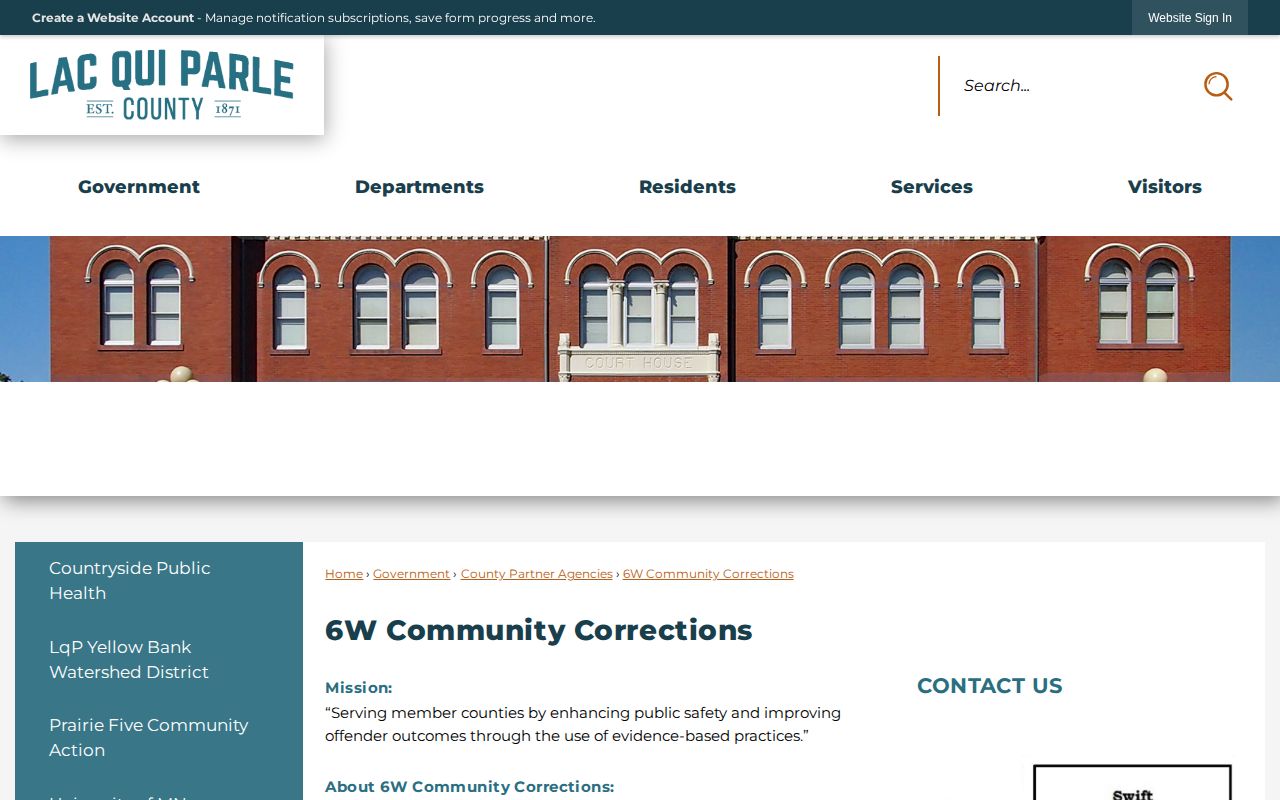
The captured county page supports the local office route, but it does not turn 6W into a searchable public roster. Verification still depends on the court record, MN DOC record, assigned worker, and what the agency may lawfully disclose.
That division also helps prevent a common error. A court may order probation in a county case without any state-prison term. In contrast, a person on supervised release has left state prison but remains within the sentence. Both may report through a local office, yet the authority and source records differ.
Lac qui Parle Supervision Violations
Conditions are the rules attached to supervision. Their exact wording comes from the court order, release documents, or agent instructions. Public records may show later allegations, violation hearings, warrants, or amended terms. They do not justify assuming that an allegation was proved. Use the most recent order and status entry.
An absconder is a person alleged to have stopped reporting or evaded supervision. MN DOC publishes an Active DOC Fugitives list for people serving the rest of a sentence in the community who allegedly violated supervised-release terms and are evading authorities. A fugitive listing can show that release to supervision occurred before the alleged violation. It does not show final discharge, and it does not prove the person is free from custody now.
The MN DOC Active Fugitives page is the state’s public channel for that limited category. DOC also publishes a 24-hour fugitive tip line at 651-603-0026.
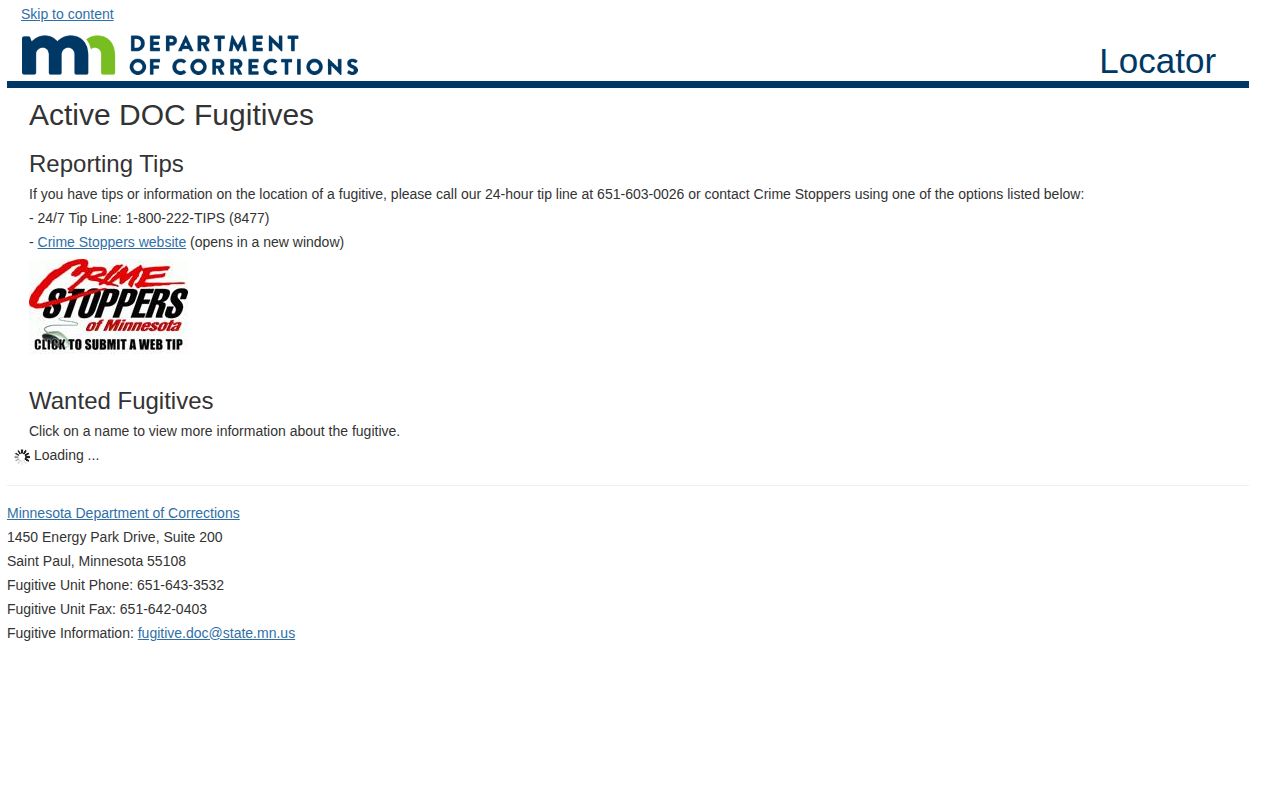
This list concerns alleged supervised-release violations under MN DOC authority. It is not a county warrant list, a list of every probation violation, or proof of a new conviction.
Note: Minnesota VINE tracks participating jail custody events, while Minnesota Haven is the notification route for people sentenced to MN DOC.
Lac qui Parle Parole Hearings
The Minnesota Supervised Release Board became the relevant board on July 1, 2024 for defined discretionary cases. It handles certified adults, indeterminate or life-sentenced people, and specified criminal-sexual-conduct cases after the applicable minimum term or parole eligibility date. Ordinary modern fixed sentences usually follow the statutory prison and supervised-release structure instead.
An initial readiness review occurs three years before the minimum term in covered cases. It cannot authorize release before that minimum. At a later review, the board may set a projected release date or continue the case with further directions. Treatment, assessment, a release plan, sentence type, offense date, and statutory eligibility all matter. A generic date estimate is unsafe.
The Supervised Release Board schedule page publishes upcoming meetings, agendas, a current review schedule, streaming information, and approved minutes. The research found that past minutes remain there for about 90 days, not a permanent name-searchable decision archive. Board minutes and annual reports may record a grant, continuation, projected date, or final-discharge decision.
A board grant is not proof that staff completed physical release. Confirm execution through Current Status, the caseworker, Minnesota Haven, or a DOC record. Board questions may be directed to MNParoleInput.DOC@state.mn.us or 651-361-7100.
Lac qui Parle Supervision Discharge
Supervision ends through a formal discharge, not simply because a person no longer lives in a facility. In a probation case, the court docket may show a discharge entry or order. In a state case, Expiration Date and Current Status help explain whether MN DOC jurisdiction continues, but the underlying DOC record is the stronger source when the public Locator no longer displays the person.
Minnesota law also separates release from final discharge in board-controlled cases. Section 244.05 authorizes certain final-discharge decisions within its limits. The first community release and the later end of all supervision are distinct events. The public record should be read with that sequence in mind.
Under Minnesota Statutes section 13.85, some corrections data can be nonpublic, including protected medical, psychological, financial, investigation, informant, safety, and security information. A public gap does not prove that supervision never existed. Public court information remains public to the extent stated by law.
If final status cannot be resolved, request the existing MN DOC record through the department’s offender-record process. Ask for the record that shows supervision and discharge rather than asking staff to create a new explanation. Clear identifiers, including the full offender ID and court-file number, reduce confusion.
For a county probation matter, compare the discharge entry with the original sentence and any later modification. A stayed prison term, probation term, warrant, or violation entry can change how the docket reads over time. For a state supervised-release matter, compare the public status with the expiration field and caseworker details. If the person has fully left DOC jurisdiction, the public Locator may no longer provide the record. In that situation, an offender-record request and the court file supply the documented path. Neither a stale screenshot nor silence from a notification service establishes final discharge.